Author: Akash

  • Beyond Homo Economicus: Why Social Identity Matters in Predicting… Well, Anything

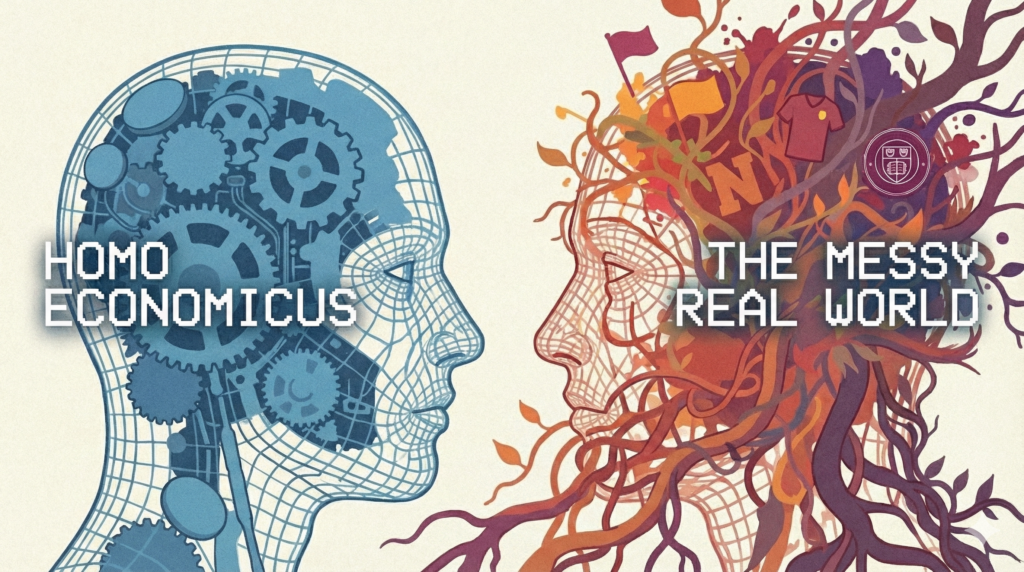
    For a long time, the dominant economic models operated under the assumption of Homo Economicus – that perfectly rational, self-interested agent whose sole motivation is maximizing their own utility, usually through consumption. Reciprocity? Fairness? In-group loyalty? These weren’t really part of the core model. It was a clean, elegant framework, great for certain predictions, but increasingly strained when trying to explain actual human behavior.

    Take politics, for instance. Decisions about voting, policy preferences, or even where you buy your coffee can often feel driven by something far more complex than simple cost-benefit analysis based on individual consumption. They feel… tribal. Influenced by who we are and who we identify with.

    This is where the concept of social identity bursts onto the scene, reminding us that humans aren’t islands. We belong to groups – families, communities, nations, fan clubs, academic disciplines (hello!). And these identities profoundly shape our behavior, our preferences, and even our economic decisions.


    One of the seminal papers that really pushed this idea into mainstream economics is George Akerlof and Rachel Kranton’s “Economics and Identity” (2000). Their core idea is brilliantly simple yet powerful: individuals derive utility not just from what they consume, but also from their identity and the extent to which they act in accordance with the “norms” or prescribed behaviors associated with that identity. This adds a whole new dimension to the utility function, moving beyond just goods and services to include psychological and social factors. Acting against your group’s norms can impose a “cost” (identity discomfort), while conforming can provide a “benefit” (identity affirmation).

    Building on this, researchers have started to rigorously model and experimentally test the impact of identity. Yan Chen and Sherry Xin Li’s paper, “Group Identity and Social Preferences” (2009), is a fantastic example. Using controlled experiments, they show how simply assigning individuals to arbitrary groups can significantly impact their behavior in economic games, leading to greater cooperation and trust within the group (in-group favoritism) and sometimes discrimination against those outside the group (out-group derogation). Their work, and others like it, demonstrates the methodological rigor that can be applied to study these seemingly fuzzy social constructs.

    Why does this matter for “Predicting the Rational”? Because ignoring social identity means missing a massive piece of the puzzle. Whether it’s understanding consumer choices driven by brand loyalty (identity as a consumer), labor market decisions influenced by professional norms (identity as a worker), or even financial decisions shaped by peer group behavior, identity is always lurking in the background, influencing what we perceive as rational or desirable.

    Incorporating social identity allows us to build richer, more accurate models of human behavior. It’s a crucial step in expanding the scope of economic inquiry beyond the simplified Homo Economicus and grappling with the beautiful, messy complexity of real people.

    So, as I continue my journey through behavioral economics, understanding social identity is high on the list. It’s not about predicting the irrational, but perhaps about realizing that what looks irrational from a purely self-interested perspective makes perfect sense when you factor in who people believe they are and who they belong to.

    Stay tuned for more musings!

    Citations:

    • Akerlof, George A., and Rachel E. Kranton. “Economics and Identity.” The Quarterly Journal of Economics, vol. 115, no. 3, 2000, pp. 715-753.
    • Chen, Yan, and Sherry Xin Li. “Group Identity and Social Preferences.” The American Economic Review, vol. 99, no. 1, 2009, pp. 431-457.
  • Travelling with a Brush

    Travelling with a Brush

    Guest Post: This is a post by Mansi Sood, a grad student at CMU and an avid painter. Please check out more of her stuff here.
    Two years ago, while writing my grad school applications, I realized how
    profoundly a passion for painting has shaped me as a person and
    informed my choices.  As I moved to the US for a PhD, somewhere between
    adapting to a new environment, and beginning a new phase in my life,
    painting had taken a backseat. During these times of uncertainty and confinement,
    I again found myself gravitating towards painting. In addition to
    documenting my surroundings, I have been reliving memories with my brush
    through the lock-down. I grew up in a constantly evolving landscape. In
    my mind, I have a thriving visual repository of dramatic skies,
    flowering meadows, glistening peaks and crashing waves. Moving to
    Pittsburgh added another chapter in this repository of memories. It was
    my first time witnessing fall, and seeing trees blossom after a long
    winter. This spring, I paid particular attention to when different
    plants in my neighborhood bloomed. On my walks, I would observe the
    contours of magnolia petals and wonder what color flowers would the
    rhododendron bushes bear. During days spent in isolation, as the sun set
    and I could no longer look outside my window, I escaped the confines of
    my room through my brush. Painting in watercolors
    has been a meditative pursuit for me. Building up paintings, stroke by
    stroke fills me up with the memory of the subject and how it made me
    feel. 
     I don’t like controlling
    paintings too much, I perceive paintings as having a will of their own,
    with my role being merely to guide them a little with my brush. 
    The
    interplay of colors and water always find a way to surprise me. During
    moments spent holding a brush, I feel engaged and calm, and grateful for
    this trusty companion, who has been by my side through these unsettling
    times.

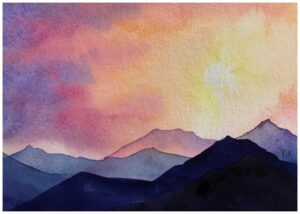
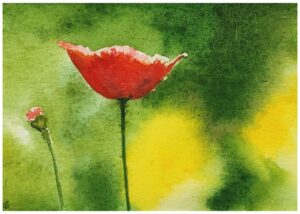
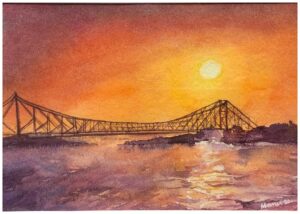
    I have tried to capture the colors of the 4 seasons in the paintings below. Which color palette goes the best with each season- winter, spring, summer and fall?

    The Himalayan Peaks from a Plane

    Bloom Time in Pittsburgh

    Sand and Sea in Okinawa

    Howrah Bridge at Sunset


  • Journey to Japan

    Journey to Japan

    I went to Japan with my sister nearly an year ago. It was a 15 day trip and we left in the first week of June. The 15 days spanned the tropical island paradise of Okinawa, quaint towns and villages in the Hida mountains, the mega-city thrills of Tokyo and a bunch of other places like Hiroshima and Kyoto on the way. I was also seeing my sister after a long time who flew to Tokyo from Pittsburgh. And this was the first time that the two of us were traveling together without any parental supervision. So, I was really excited!
    I was busy with preparation for a Math exam scheduled for the end of May. So, the majority of planning was down by my mother and sister. My mother is the planner in chief for all travel itineraries in our family. Despite being a busy professor at a big public hospital, with a lot of responsibilities at work and home, her travel plans can put the most hardened backpackers to shame in terms of frugality, ambition and hatred of cliched tourist traps. The first iteration of our itinerary included landing in Tokyo, a hike to Fuji, flying to Okinawa, flying back to Kyoto, visiting Hiroshima and Takayama in the Hida mountains (Japanese Alps), taking a Shinkansen to Hokaido and then back to Tokyo. Its a testament to the depth of her research and conviction about what constitutes a good itinerary, or perhaps our travel immaturity, that my sister and I decided to go ahead with the entire thing less Hokaido. I’m glad that we did because as the itinerary was turned out perfect.
    My Japan itinerary
    Photographs by reflect_color
    (trip details pending)
  • Bonding Over Radio

    Bonding Over Radio

    Yesterday’s weather was uncharacteristically pleasant for the month of May in Delhi. I was lying in my room after dinner and listening to Ruskin Bond narrate his “The Eyes Have it” on the radio. I had switched off the lights in my room. I had my window open because it had been a rainy day and there was a nice cool breeze. The reception was patchy and I the could hear lots of static. It had taken some effort to find a corner of the room where the static was low. Bond’s warm voice flowing from the radio with his impeccable English made the experience timeless.
    Source: https://pixabay.com/photos/rain-water-window-dark-night-room-2589417/
    This picture captures how I saw the world outside my window, lying on my bed. Bond’s narration lasted for just 15 min but
    those 15 min seemed borrowed from another era. I was reminded of those
    small radio clips of important historical announcements that you get in
    movies and documentaries. The opening lines of Nehru’s tryst with
    destiny speech, IG announcing the imposition of emergency and a news
    announcer declaring that India was now in a state of war with Pakistan
    after airfields in Ambala had been bombed by the PAF. I was filled with a
    strange feeling which I find hard to describe. I guess it was the just
    the similarity in the medium for those broadcasts- the radio. Or perhaps
    just a yearning for being present at those pivotal occasions. Whatever
    the cause may have been, at that moment, I was filled with what I can
    best describe in a word as nostalgia. A quick google search shows that there is a word for that- anemoia. I guess, nostalgia is a feeling of familiarity which doesn’t always connect to actual memories. Politicians seem to exploit it all the time. Isn’t it what makes Trump’s supporters fired up about “Making America Great Again”? Or, Hindu Nationalists misty eyed about India as a “Sone ki Chidiya”. The relationship between nostalgia and populism deserves a separate post. I will try to do it, but no promises.

    For now, I wonder which
    announcements (videos and not audio most likely) will go down in documentaries
    for the COVID19 pandemic? I think the lockdown announcements will
    surely make it and also Trump’s many faux pas. But, what about the
    millions who are starving or migrants whose trains home were cancelled?
    None of that will make it into the big budget movies/documentaries, of
    course. Perhaps, in the age of social media and camera phones
    everywhere, their voices might get recorded. And, they may find a
    place somewhere in the audio/visual historiography. I really hope they
    do. 


  • Uncertain Thoughts On Uncertainty

    Uncertain Thoughts On Uncertainty

    I don’t know if we are living in the best of times or the worst of times. It’s likely worse for most people compared to what they were living in a few months back. At the same time, it’s definitely the best of times for Jeff Bezos who saw his fortune increase by 40% in the same period. It’s a time for heroes- our doctors and health workers who are treating the infected and policemen who are enforcing the lockdown, some of them without adequate protection. And a time for villains spreading misinformation and profiteering off desperate people. The only thing that I am absolutely sure of is that we are all living in the most uncertain of times.

    I find the idea of uncertainty intriguing. The mathematical view of uncertainty is embodied in the concept of probability. Consider the tossing a coin and assigning 0.5 to the chance of getting a head. The number 0.5 is our assessment of an even happening in an uncertain future. There are two ways of interpreting this assessment, given by two schools of probability- Frequentist and Bayesian. The Frequentists will say that 0.5 is the asymptotic ratio of number of times a head comes up by the total times number of times the coin is tossed. You might get 2 heads and 1 tails for a ratio of 0.6 if you toss a coin thrice. But, if you repeat the experiment a large number of times, the ratio will always converge to 0.5. The Bayesians on the other hand will say that 0.5 is the quantification of a reasonable belief that the coin will come up heads, consistent with evidence after a large number of experiments and updates. A Bayesian acolyte might start with a prior belief that the probability of a coin being heads is 1 but he will update his belief with data from experiments and reach the correct belief which in our case would be 0.5. Thus, there is a certain degree of uncertainty about how to interpret the idea of uncertainty in Mathematics itself, arguably the most certain of sciences.
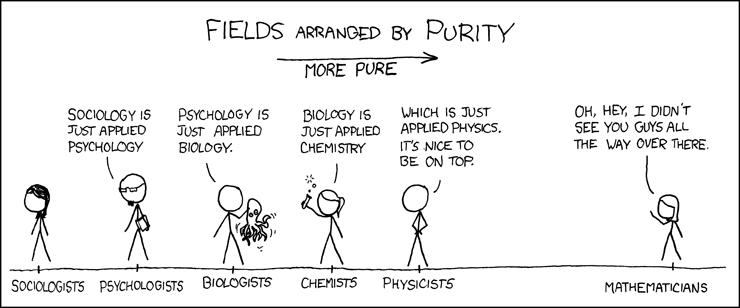
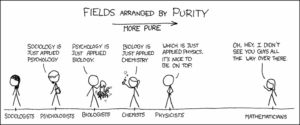
    Well purity is just a measure of lack of uncertainty, right?
    Source: https://xkcd.com/435/

    Adding
    economics to diagram above would probably put it far to the left in the diagram, even
    further left than sociology. Most 18th and 19th century economists
    like Adam Smith, Marx, Ricardo, and Marshall would probably have put it there. Basically,
    at any time before the mathematical revolution in economics, starting in the 50s,
    the goal of an economist would have been to apply ideas from sociology and
    psychology to understand how the economy behaves. The pioneers of the mathematical
    revolution aimed to take economics more right on the diagram and dreamed of bringing
    it near physics. The economic models that emerged were mathematically elegant but
    were based on the core tenet of agents being rational- fully optimizing- in
    every situation. These models, especially in microeconomics, could not explain real-world
    data that became increasingly available from the 80s. The pioneering work of Simon,
    followed by Kahneman, Tversky and others provided alternative models for behavior
    that did not rely on rationality assumptions. This started a movement towards
    the left diagram from the diagram and today economics has again started to
    incorporate ideas from sociology and psychology into understanding how economic
    agents actually behave. 


    Literature
    (incomplete)
  • Death and the Pigeon

    Death and the Penguin is a Russian novel set in 90s Ukraine by Andrey Kurkov. It is a dark, satirical, and strangely surreal look at the adventures of a down on his luck every-man, living in Kyiv, with his pet penguin. The bond shared by the man and his penguin is deeply emotional and has been written beautifully. It captures the effect of the turbulent political situation and financial ruin faced by people in the wake of the Soviet Union’s collapse.

    The unpredictability of everyday life where the economy had collapsed and the state had been taken over by rival mafia gangs pervades the pages of the book. This book, more than any work of non-fiction, gave me a glimpse of how it must’ve felt for people to live though those times when the rigid certainties of the Soviet era were suddenly replaced by anarchy and uncertainty within a few years or even months. Developing an understanding of this period of history helped me appreciate how politics in Russia and Ukraine in the Putin era are shaped by people’s dread of the chaos of the early 90s. It also gave me an idea why middle aged Russians today support Putin’s policies advocating security and stability of the state at all costs. I would highly recommend the book to anyone interested in this period of history.
    The bird that prompted me to write this post was not a penguin, but a more commonplace member of the avian family. A couple of days ago, a pigeon crashed into my room’s glass window and died. I usually draw my curtains in the morning because the summer sun in Delhi can get really hot. I forgot to draw them the entire way that day and the pigeon mistook a section of glass window, not covered by  curtains, as a portal to shade in my room in the afternoon heat. Unfortunately, the way to that shade was blocked by two inch thick glass- an inch (two) far. The coronavirus lockdown in India has been hard on the poor and other people on the margins, especially migrants who eke out a precarious living in the best of times. Even animals like dogs, cows and pigeons who, in a way, also live on the margins of human society, have been affected by the lockdown. 
    The incident with the pigeon brought home, quite literally, the uncertainty and chaos being faced by a large section of our population to my comfortable middle-class existence. News reports about people walking hundreds of kilometers in the summer heat to their homes, not getting enough food and being mistreated seem more corporeal. A friend had recently shared an article talking about how these people who face so much uncertainty due to the coronavirus pandemic and the consequent lockdown have been forgotten by not just the government, but also us- their more privileged fellow citizens. 
  • Hello World

    I bought a new domain! I plan to shift my blogging and and non-academic writing here. My academic writing that is too far ahead of its time to be appreciated by editorial committees, i.e., nonpunishable will also go here.
    I am excited about the possibilities of experimenting with different things related to website design. I am yet to figure out a web-host for this website. So for now, only the following urls are working:
    • My personal blog on grad school life at UMich from fall 2020, assuming the corona Gods are kind, that I have shifted here from blogger. I’ll stop posting to other blogs and will consolidate all my blogging activities here.
    • The google site page that my sister had made for my applications to grad school last year.
    I plan to be more regular in posting on this blog than my last one. Let’s see how that works out!
  • April is the Cruellest month

    Hey everyone, and welcome back to Predicting the Rational, the blog where I bravely attempt to apply structured thinking to the glorious chaos that is human behavior. Today, we’re talking about April. Ah, lovely, sunny April. Birds are singing, flowers are blooming, taxes are due… and according to T.S. Eliot, it’s the cruellest darn month of the year. Which, frankly, is a bit of a mood, right?

    Eliot’s line, “April is the cruellest month, breeding / Lilacs out of the dead land, mixing / Memory and desire, stirring / Dull roots with spring rain,” is pure poetry, yes. But isn’t there something behaviorally suspect about it? Winter is easy. Everything’s dead or asleep, covered in a nice, predictable blanket of snow or just general bleakness. Our expectations are low. But April? April shows up, demands renewal, shoves beauty in your face, and suddenly all those things you successfully repressed since, oh, probably last April, come bubbling up. It’s like spring is gaslighting us with sunshine while we’re trying to process, well, everything. From a psychological standpoint, maybe that contrast is the cruelty – the vibrant external world throwing your internal landscape into harsh, uncomfortable relief. It’s rude, honestly.

    Remember April 2020? It already felt like the world was upside down, and then came the heartbreaking news about Irrfan Khan and Rishi Kapoor. Losing such beloved figures, especially in a month typically associated with new beginnings, felt particularly jarring, almost… wrong. The reference to Eliot’s line in the letter from Irrfan’s wife resonated because it perfectly captured that feeling of a beautiful month delivering profound sadness. It’s like the universe had a particularly cruel sense of irony that year.

    Now, for something completely different, but equally indicative of April’s potential behavioral pitfalls: car crashes. I swear I read somewhere (and please, don’t take this as peer-reviewed financial advice, or really, any kind of advice) that fender benders supposedly tick up in April. The alleged reason? Drivers (let’s be real, the article probably implied male drivers, adding another layer of eyebrow-raising behavioral data) might be… a little distracted by the sudden appearance of summer fashion after months of winter coats. Look, I’m not saying it’s definitely true, but isn’t there a wonderfully absurd behavioral economics angle there? Forget complex decision trees! Maybe risk assessment on the road is influenced by… seasonal sartorial changes and attentional capture? It’s a quirky, slightly terrifying thought, suggesting our “rational” driving choices might be influenced by factors entirely outside the traditional model of road safety.

    And if that’s not enough April-induced behavioral weirdness, let’s throw in Ismail Kadare’s haunting novel, Broken April. The premise involves an ancient Albanian custom where a man is practically fated to commit a murder and then live the month of April under the shadow of being killed in retaliation, all dictated by a strict, cyclical code. It’s an extreme example, but it speaks to how deeply ingrained cultural norms and a sense of predetermined fate (perhaps felt more acutely as nature follows its predetermined cycle in spring?) can override individual will and rational self-preservation. You thought balancing work-life was hard? Try living by a calendar where April means a literal date with destiny dictated by generations-old rules. It makes you wonder about the “rationality” of following norms, even deadly ones, and how much our choices are truly our own when steeped in tradition and expectation.

    So, what’s the behavioral econ takeaway from all this April madness? Maybe it’s that predicting human behavior isn’t just about calculating utility maximization in a vacuum. It’s about understanding how our internal emotional states (amplified by external contrasts), our susceptibility to environmental distractions (shiny things! new clothes!), and the heavy, often irrational weight of cultural narratives and perceived fate all conspire to make us act… well, like humans.

    April might be cruel in the poetic sense, but perhaps its greatest cruelty, for us behavioral economists anyway, is how starkly it reveals the limits of purely rational prediction. It’s a beautiful, messy, distracting, and sometimes heartbreaking reminder that the “rational” is always, always interacting with the wonderfully unpredictable “irrational” within us all.

    Stay quirky, stay kind, and maybe drive extra carefully this month.